
All Eyes Still on Islamabad as Talks End Without a Deal
By Junaid Qaiser
At a time when the Middle East seemed on the brink of deeper conflict, Islamabad stepped up as an unexpected yet crucial diplomatic player. A fragile ceasefire opened the door for dialogue, and suddenly, all eyes were on Pakistan. For a fleeting moment, it looked like a breakthrough might be just around the corner. However, as the latest round of intense negotiations wraps up without a deal, the narrative shifts from mere opportunity to themes of resilience, perception, and what lies ahead.
Pakistan’s leading role in fostering dialogue between the United States and Iran was the result of ongoing, intentional efforts spearheaded by Prime Minister Shehbaz Sharif, with strong backing from Chief of Army Staff Field Marshal Asim Munir. Their united strategy played a pivotal role in steering the situation away from escalation, paving the way for both parties to come together for talks in Islamabad.
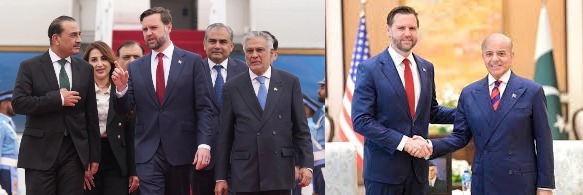
The effort hit a pivotal moment with the arrival of U.S. Vice President J.D. Vance, who made a grueling 16-hour journey to engage in what many called historic discussions with Iranian leaders. He was welcomed at PAF Air Base Nur Khan by Field Marshal Asim Munir, Deputy Prime Minister and Foreign Minister Mohammad Ishaq Dar, and Interior Minister Mohsin Naqvi. This visit underscored the heavy expectations on Pakistan as the host and mediator. For nearly 21 hours, the negotiations took place behind closed doors.
The stakes were undeniably high: the goal was to transform a fragile ceasefire into something more stable and possibly mend a long-standing adversarial relationship. However, by Sunday, the results didn’t quite meet those hopes. After the talks, Vice President Vance told reporters that no agreement had been reached.
“The bad news is that we have not reached an agreement,” he stated, emphasizing that the United States had clearly outlined its red lines. The American delegation left Islamabad, leaving behind an unresolved situation and a ceasefire that, while still intact, now seems more precarious.
And yet, even if the talks didn’t lead to a concrete deal, they accomplished something else—something a bit harder to pin down, but still strategically important. Recently, Pakistan’s standing on the global stage has seen a remarkable transformation. After Prime Minister Shehbaz Sharif announced a 14-day ceasefire, the international community’s view of Pakistan has shifted dramatically. Where there was once a cloud of skepticism, there’s now a growing acknowledgment of Islamabad’s role in diplomacy.
A social listening analysis by Ipsos highlights this change with striking clarity. Just weeks ago, global perceptions were largely negative, but they flipped to a more positive outlook following the ceasefire announcement. This wasn’t a subtle shift—it was a clear and decisive change. Online discussions began to tell a new story: one where Pakistan is no longer viewed through the lens of its past challenges, but rather as a proactive and credible mediator.
Expressions of gratitude from around the world came pouring in. The hashtag #ThankYouPakistan started trending, with users from various regions acknowledging Islamabad's role in averting a larger conflict. Observers noted the impressive teamwork between Prime Minister Shehbaz Sharif and Field Marshal Asim Munir, pointing out a rare moment where civilian and military leaders united for a diplomatic solution.
Deputy Prime Minister Ishaq Dar’s messaging throughout the process remained consistent: a call for constructive engagement and a reaffirmation of Pakistan’s commitment to facilitating a lasting and durable solution. That position has not changed, even as the immediate outcome has fallen short.
Prime Minister Shehbaz Sharif, too, has framed the situation with a measure of realism. The ceasefire, he emphasized, was never an end in itself, but a beginning—a narrow window through which a more comprehensive settlement might be pursued. That window has not closed, but it has narrowed.
For Pakistan, however, the implications extend beyond the outcome of any one meeting. In stepping forward at a critical moment, Islamabad has repositioned itself on the global stage. The Ipsos data, describing this as a “transformative moment,” reflects more than a shift in perception—it signals the emergence of Pakistan as a credible diplomatic actor capable of convening adversaries and shaping dialogue.
This does not mean the task ahead is easier. If anything, it is more demanding. The transition from hosting talks to sustaining a process requires persistence, strategic patience, and continued trust from all sides. The risk of renewed escalation remains real, particularly in the absence of a formal agreement.
But for now, one reality stands out: even without a deal, Pakistan has altered the diplomatic landscape. It has demonstrated that in moments of crisis, influence is not solely the domain of traditional power centers—it can also belong to those willing to mediate, to convene, and to persist.
The talks may have ended without resolution, but the story is far from over. And as the world reassesses both the risks and the possibilities, one thing remains unchanged—attention, expectation, and perhaps even cautious hope, are still fixed on Islamabad.
No comments yet.